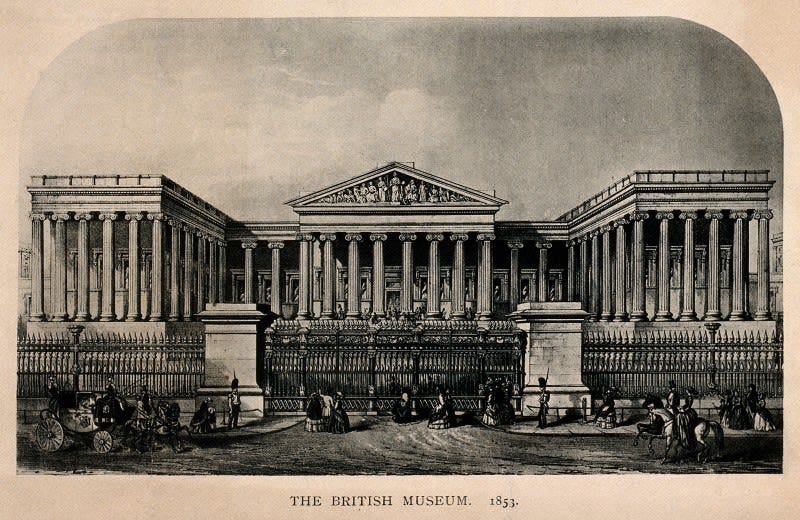
The British Museum in London is one of the most visited museums in the world. While it holds the fourth position in terms of annual visitors (4 million in 2022), trailing behind the Louvre in Paris, the Vatican Museums, and the Natural History Museum (London), it is arguably the most significant and influential institution of its kind. The museum boasts a permanent collection that exceeds 8 million objects, making it the largest museum in the world, dwarfing all others. By comparison, the Louvre has only 490,000 in its collection. The British Museum also claims to be the first global ‘public national museum to cover all fields of knowledge’—a ‘universal museum’. To understand the significance of such numbers and claims, the question must be asked: why were museums established, and what purpose do they serve today?
According to UNESCO, there are an estimated 100,000 museums worldwide, 70% of which are located in Europe and North America, and 20% in the Middle East, Africa, and the Asia-Pacific region. Museums are considered to be an essential part of the preservation of historical heritage and local traditions. They are an invaluable cultural and historical resource, independent of politics and ideologies, and are deserving of an unquestionable place in our societies and imaginations. However, were museums created for this purpose?
When the British Museum first opened its doors in 1759, it had a collection of 71,000 items, all bequeathed by a man named Hans Sloane. Sloane’s career as a collector fortuitously began during his time in Jamaica, where he had been working as a doctor on the British Empire’s slave plantations. He later married an heiress to sugar plantations, amassing great wealth that allowed him to accrue even larger collections from around the British colonies. These included rare books, manuscripts, coins, medals, natural history, art, antiquities, and ethnographic materials. In his will, Sloane gifted his entire collection to the British government on the condition that it would be freely accessible to the general British public. His condition was partly met, as the poor were initially excluded, and the British Museum was born.
While what Hans Sloane collected was by no means unique (many rich European aristocrats had similar collections), he set a precedent for just how much one could easily acquire in such vastly different areas (‘all fields of knowledge’) from around the world for no apparent purpose. Sloane cemented the idea that he, as a European, could and would be the custodian of mankind’s knowledge and history, and whether or not he understood the value or purpose of his collections was irrelevant. Serious investigative work could be done later, if needed. In the 260 years since Sloane’s death, the British Museum collection has grown from 71,000 to a staggering 8 million objects through what the museum calls ‘difficult histories’. According to the museum, the acquisitions were made through ‘colonial acquisition and missionary activity’, ‘conflict’ [read: war and genocide], ‘purchase and commissions’, and ‘excavations and donations and bequests.’ While such honesty might surprise some, it shouldn’t. The British Museum is well aware of its dark colonial past and has strategies fine-tuned to deal with criticism. It writes: ‘The British Museum acknowledges the difficult histories of some of its collections, including the contested means by which some collections have been acquired, such as through military action and its consequences.’
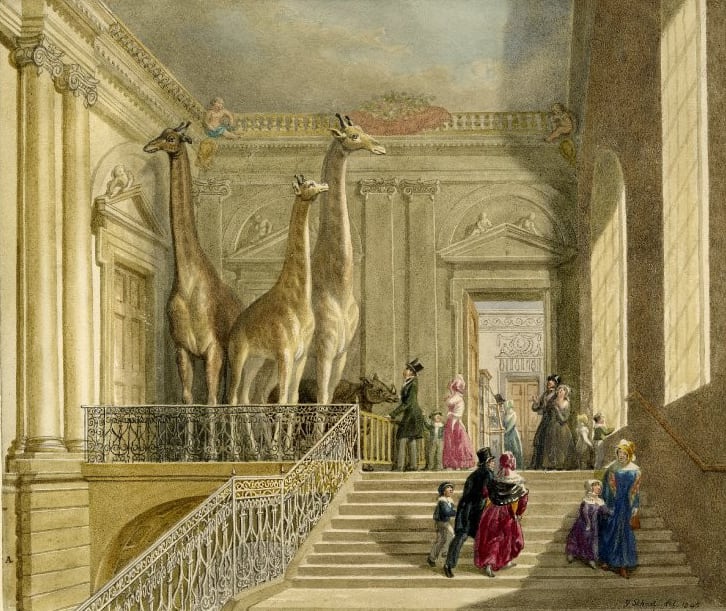
The museum is well aware that old colonial tactics are no longer effective, and it has no choice but to at least acknowledge what had previously been denied. The question of returning collections will be dealt with later, or never, it hopes. The British were not unique in this. The French, Dutch, German, and Belgian governments followed the same practices in filling their ‘national’ museums (see: The Louvre in Paris or the Pergamon Museum in Berlin). It was in this period that certain other ‘oriental’ disciplines, such as Egyptology, were born out of a European obsession with the East and its people. The East, home to the oldest of human civilisations, suddenly became a mystery that needed to be investigated. According to Edward Said, the Western speculation of the East (and of itself) is such that the European adventurer, whether a collector, sociologist, artist, or writer, must represent the Orient. Only he, the enlightened man of reason, could illuminate the darkest parts of the world to discover what the irrational native could not bring himself to do. If the native wished to represent himself, ‘it is only credible after it had passed through and been made firm by the refining fire of the Orientalist’s work’ (Said). This practice and belief system formed part of a wide and deeply institutionalised European phenomenon that led to the pillage, exploitation, and an ultimately irreversible transformation of the East. Edward Said called this Orientalism.
‘On the one hand there are Westerners, and on the other there are Arab-Orientals; the former are rational, peaceful, liberal, logical, capable of holding real values, without natural suspicion; the latter are none of these things.’
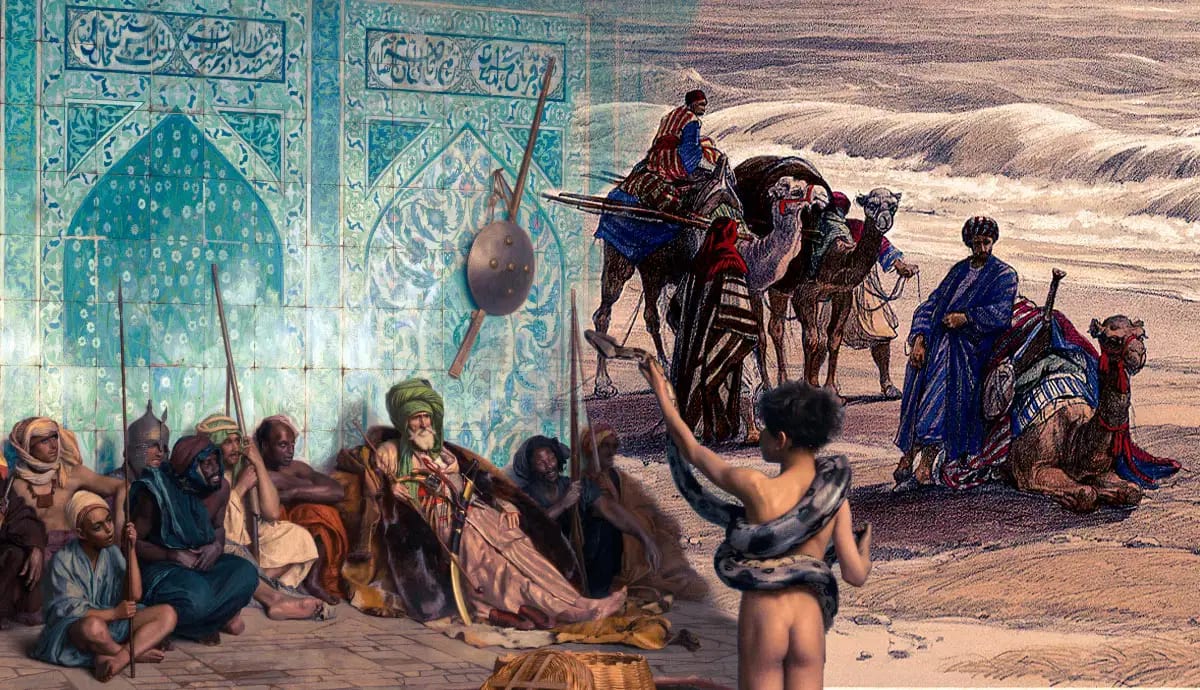
By representing the Orient this way, the West was creating an equal and opposite impression of itself for itself. There is perhaps no single event that demonstrates this phenomenon better than the conquest of Egypt by Napoleon in 1798. Alongside his army, Napoleon took hundreds of academics, historians, and scientists to document the architecture, objects, and people of Egypt. The resulting studies were the first of their kind by a European colonial power and would pave the way for other Western powers to document the people of lands they would conquer in the same way. The native also began to appear in literature, i.e. Heart of Darkness by J. Conrad, The Jungle Book by R. Kipling, or in the Orientalist Art movement (see the works of John Frederick Lewis). But the physical manifestation of the colonial imagination was exhibited in museums. If one visited a European museum in the early nineteenth century, alongside displays and studies on the natural sciences (botany, etc.), one would find the native and his world on display in glass cabinets and museum halls—as if the Orient was no different than the natural and bestial world. Both were worthy of speculation and theory.
The eighteenth and nineteenth centuries saw a rapid increase in private collections of objects from the East. While some collections were acquired by private collectors or fortune seekers, the majority of them were taken by government agents directly or by their armies as a result of war (see the Benin Bronzes). So what is the future of the British Museum?
British Museum Today
Though colonialism is long over, British imperialism lives on, and there is no better example of this than in the British Museum. The historical obsession of the British Museum with representing the ‘other’ in its collections has been revealed, but if we look at the museum today, it is evident that not much has changed. One must then ask the question: Has the need to represent the ‘other’ endured in the mind and imagination of the British (and by association, the European)? Furthermore, what tools of rationalisation are being employed to justify the parallel existence of what Said called ‘Orientalism’ and what the British Museum claims to be its ‘ideals and values of enlightenment’? In the language and lexicon used by the British Museum, it writes:
“Enlightenment ideals and values – critical scrutiny of all assumptions, open debate, scientific research, progress and tolerance – have marked the Museum since its foundation.”
The ‘About Us’ page of the museum states:
“The British Museum is unique in bringing together under one roof the cultures of the world, spanning continents and oceans. No other museum is responsible for collections of the same depth and breadth, beauty and significance.”
It is bizarre that a ‘modern’ institution in the twenty-first century can use such lofty imperial-era claims of self-importance which are easily contradicted through a basic reading of history. To the British Museum, it appears that the centuries of British colonial rule, with all its barbarity, violence, and exploitation, are merely an inconvenient footnote. While the rest of the world might have moved on from such brazen public self-righteous rhetoric, the museum is somehow excused and can carry on believing that for it, the age of enlightenment never ended. As a single institution in an increasingly isolated and irrelevant country in European and global politics, it possesses a ‘uniqueness’ and a mission to bring together all the ‘cultures of the world’ that span ‘continents and oceans’—the ‘universal museum’. The audacity of the British Museum to plead ignorance and then celebrate the violent and genocidal history (see the Bengal famine of 1943) that led to it acquiring some of its most spectacular collections could only be understood, not justified, by Orientalism.
“To say simply that Orientalism was a rationalisation of colonial rule is to ignore the extent to which colonial rule was justified in advance by Orientalism, rather than after the fact.” — Edward Said (Orientalism)
Orientalism as Self-Identification
According to Said, the Orientalist assumes some sort of ownership, precedent, or prior knowledge of the Orient (the ‘other’) to which he refers and on which he relies, not to understand the Orient but to understand himself. The British Museum’s past and recent history indicate that it is going through a self-identity crisis. It is unable to accept that its future can be based on anything other than its colonial-era collections. Acknowledging its ‘difficult history’ is one thing, but taking action based on it is another. The museum and the British government have been so afraid of returning collections that in 1963 the British parliament passed a law that prohibits the museum from returning objects, followed by another in 1983. Without repatriations, the museum will remain under permanent scrutiny. But this is a uniquely British Museum position. In recent years, some European museums have begun to return some of their many contested collections, signalling their acceptance to change with the times. But the British Museum has doubled down. In response to the creation of some unofficial tours by its critics that take visitors through the contested collections, the British Museum followed the trend and created its own tour of twenty-one contested items, naming it a ‘Collecting and Empire Trail’. It appears as if the museum not only accepts the controversy, it wants to be part of it. Such self-awareness confirms that the museum is actively paying attention to what is being said and is choosing to embrace the criticism rather than fight it. Each collection is an intimate part of the museum’s identity, and the controversy says more about the museum than it does about the collection. Losing one object, it seems, would further magnify the crisis.
At present, there are around nine official requests for reparations from foreign governments — all of which have been denied. The Benin Bronzes, a group of sculptures from the historic Kingdom of Benin; the Rosetta Stone from Egypt; and the Parthenon Marbles (Ancient Greek sculptures) are among the most requested. The museum’s refusal represents an exchange of moral power (what the British believe they ‘can do’ and ‘can understand’ vs. what the Orient ‘can’t’), which Edward Said argues is one of the many facets of Orientalism. The British establishment, and to a similar degree, other European governments, view requests from these countries as unimportant because the Orient is seen as the unequal half, and they simply can’t be trusted with custodianship. The arguments for refusal to repatriate are as follows: a) the claimant country lacks the proper facilities for preservation and display, or b) the claimant country is unstable or unsafe, thereby putting the collection at risk. The Greek government, standing as an uncomfortable anomaly being a European state, responded by constructing a dedicated museum with state-of-the-art facilities to welcome back the Parthenon Marbles. The current stance of the British Museum is that by keeping the marbles, ‘the widest possible public’ has access to them, and that because the collection is part of a wider ‘shared humanity’, the British have as much right as anyone else, and arguably even more so because their museum is a ‘universal museum’. Unfortunately for them, in August 2023, it was revealed that several thousand artefacts (the exact number is unknown) had been stolen from the British Museum’s storeroom and resold on the private market. This revelation renewed calls for reparations and exposed the hypocritical position of this antiquated institution.
It is time for the British Museum to reinvent itself. If it truly believes in the ideals of tolerance, diversity, and ‘shared humanity’, it needs to right the wrongs of the past. Only half of its 8 million objects have been fully documented and made available online, and only 1% of its total collection is ever on display in its halls. This idea of the British Museum being a ‘universal museum’, accessible to all, is a myth. Western cities — whether London, Paris, or Berlin — are out of reach for many of the people whose heritage is housed in the museum’s collections. However, a change is underway that could potentially balance the equation.
While the expression of power politics once demonstrated an uneven exchange, a continuation of old-world imperial Orientalism, a number of museums and galleries are opening in the East that are not only challenging ownership but possibly rewriting narratives. The Museum of Islamic Art in Doha, the Islamic Arts Museum Malaysia, and the Museum of Turkish and Islamic Art in Istanbul have opened up avenues for a new audience to explore art and history. Millions of visitors who might not be able to visit Europe or North America can for the first time see ‘their’ collective history in institutions that carry none of the burden of old European museums. These museums have heavy pockets and are able to ‘loan’ back objects once taken from the East. However, a danger looms that few are giving much thought to: Are these new museums simply mimicking the behaviour of the old European ‘universal’ museums, or are they re-imagining themselves outside of the framework of Edward Said’s Orientalism?